

Understandingyour liver cancer journey
Navigate Your Treatment Options
There is no single treatment plan that’s right for everyone. Liver cancer can be treated in different ways, and each approach works differently—some physically remove or destroy a tumor, while others use medicines or radiation to damage cancer cells, slow their growth, or help the body’s immune system fight them.
Your care team considers many factors when recommending a path forward. These include the type and stage of cancer, the size, number, and location of tumors, how well your liver is working, your overall health, and your treatment goals. You may receive one treatment or a combination of treatments over time. Understanding how each works can help you feel more informed and prepared for conversations with your care team.
Surgery treats liver cancer by physically removing cancer from the body. In a liver resection, the surgeon removes the part of the liver containing the tumor along with a margin of nearby healthy tissue. The amount removed depends on the tumor’s size and location and how much healthy, functioning liver can safely remain. For certain patients, a liver transplant may be considered, replacing the diseased liver with a healthy donor liver.
Systemic therapy uses medicines that travel through the bloodstream to reach cancer cells throughout the body. Depending on the type of therapy, these medicines may help the immune system recognize and attack cancer cells or target specific processes cancer cells use to grow and form new blood vessels. Systemic therapies are commonly used for advanced liver cancer and may also be combined with other treatment approaches.
Radiation therapy uses high-energy rays or particles to damage the DNA of cancer cells, making it harder for them to grow and divide. For liver cancer, highly focused approaches such as stereotactic body radiation therapy (SBRT) can direct radiation at a tumor while limiting exposure to nearby healthy tissue. Radiation may be used to control tumor growth or help relieve symptoms, such as pain, in certain situations.
Microwave ablation treats a tumor by destroying cancerous tissue rather than surgically removing it. During the procedure, a thin probe is guided into the tumor using imaging. The probe delivers microwave energy that rapidly generates heat, damaging and destroying cancer cells within the targeted area.
Ablation may be considered for patients with a limited number of small liver tumors. Whether it is an option depends on factors such as tumor size and location, liver function, overall health, and other individual considerations.
Major surgical procedure performed under general anesthesia.
Depending on the medication, treatment may be given through an IV infusion or taken by mouth as a pill, often on a recurring treatment schedule.
Most commonly through an external radiation machine. Techniques such as SBRT deliver focused beams of high-dose radiation to the tumor from multiple angles. Some patients may receive internal radiation approaches.
A thin probe is guided into the tumor using imaging such as ultrasound or CT. The procedure can often be performed without open surgery, through a small opening in the skin the size of a dime.
Pain, fatigue, nausea, temporary changes in appetite, and other effects associated with surgery and anesthesia.
Varies by medication and may include fatigue, nausea, decreased appetite, diarrhea, skin changes or rash, muscle or joint pain, and other treatment-specific effects.
Fatigue, nausea, vomiting, loss of appetite, diarrhea, and skin changes in the treated area. Side effects vary depending on the type and location of treatment.
Pain or discomfort, fever, skin irritation, and temporary changes in liver-function blood tests may occur.
Bleeding, infection, blood clots, pneumonia, complications from anesthesia, and reduced liver function. Transplant carries additional risks, including organ rejection and complications from medicines used to suppress the immune system.
Some therapies can cause more serious reactions. Immunotherapy can cause the immune system to attack healthy organs, while certain targeted therapies may increase the risk of bleeding, high blood pressure, blood clots, or liver and kidney problems.
Radiation can affect nearby healthy tissue. A less common but potentially serious complication of liver radiation is radiation-induced liver disease.
Possible complications include bleeding, infection, damage to nearby structures, and other procedure-related complications. Serious complications are possible but are not common.
Typically requires a hospital stay. Length varies based on the type of surgery, individual health, and recovery.
Many systemic treatments are provided on an outpatient basis and do not require an overnight hospital stay. Treatment may continue for months or longer depending on the medication and how the cancer responds.
External radiation is generally delivered on an outpatient basis without a hospital stay. The number of sessions varies by treatment type. SBRT, for example, may be delivered over several treatments.
Ablation can often be performed on an outpatient basis without an overnight stay, although some patients may stay for observation depending on the procedure and their overall health.
Recovery can take several weeks or longer and may include pain management, activity restrictions, follow-up visits, blood tests, and imaging. Transplant recipients require lifelong follow-up and anti-rejection medication.
Regular appointments, blood tests, imaging, and monitoring for side effects help the care team understand how treatment is working and whether the treatment plan should be adjusted.
Some side effects can continue for several weeks after treatment. Follow-up appointments and imaging are used to monitor the treated tumor, liver function, and overall response.
Recovery is generally followed by imaging and blood tests to evaluate the treated area and liver function. Care teams will provide instructions about activity and follow-up based on individual procedures.
Liver cancer can return after surgery, either near the original site or elsewhere. Continued surveillance with imaging and other follow-up testing is an important part of care.
Because systemic therapy may be used to control advanced cancer rather than eliminate all cancer cells, care teams will monitor whether tumors shrink, remain stable, or continue to grow and may adjust treatment over time.
Radiation can control a tumor in the treated area, but cancer may recur or develop elsewhere. Ongoing surveillance remains an important part of care.
Treating a tumor with ablation does not prevent new liver tumors from developing or cancer from recurring. Follow-up imaging and ongoing surveillance are important after treatment.
More Options. Better Conversations.
How Treatment Decisions Are Made

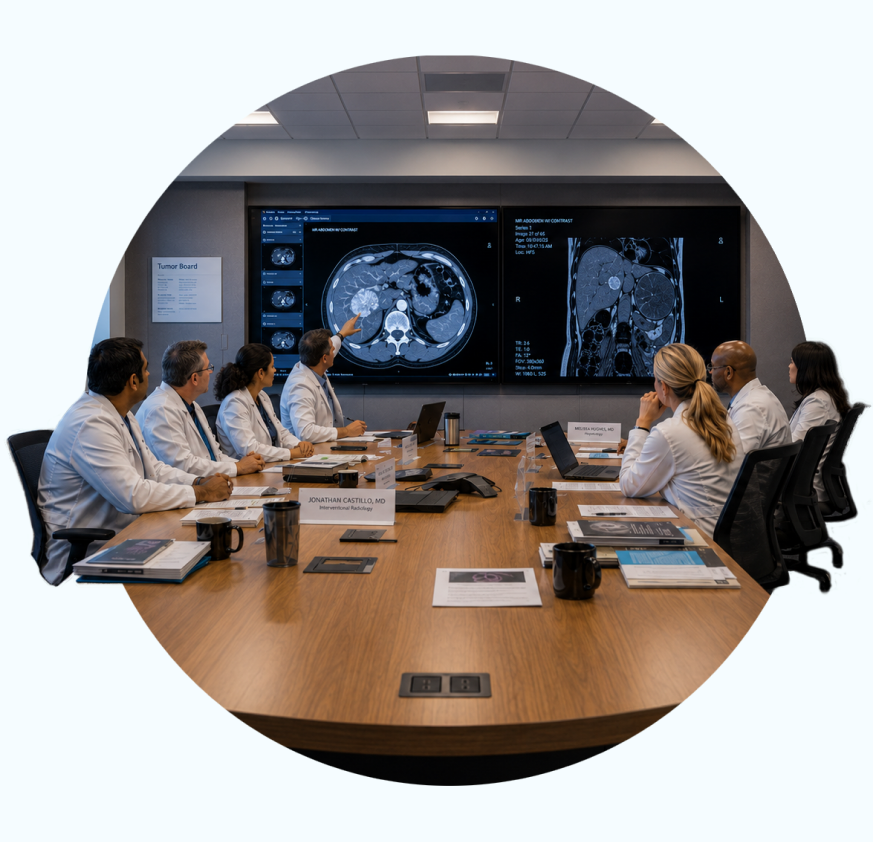
Multidisciplinary Teams
Tumor Board
Medical Oncologist
A cancer doctor who treats cancer with medicines, like chemotherapy or immunotherapy.
Surgical Oncologist / Hepatobiliary Surgeon
A surgeon who specializes in removing tumors, including those in the liver
Radiation Oncologist
A cancer doctor who treats tumors with focused beams of radiation
Diagnostic Radiologist
A doctor who reads your scans, like CTs and MRIs, to see where the tumor is and how it’s changing
Pathologist
A doctor who studies samples of your tissue under a microscope to confirm what kind of cancer it is
Referring Physician
The doctor who knows your case and sends it to the team of specialists — often the one who found the tumor
Interventional Radiologist
A doctor who treats tumors from inside the body using thin needles or probes guided by imaging. One example is the treatment called microwave ablation. This doctor is not always part of your care team from the start, so it’s okay to ask whether one has reviewed your case.